

 Back
Few football clubs have established such a strong connection as Sporting Clube de Portugal and Manchester United over the years. They have been rivals on the pitch, celebrated iconic nights together and shared some of the most influential players ever to wear both shirts.
It’s a story that revolves around a shared passion for local youth talent, a desire to compete on fabled European nights, and the image of men who both sets of supporters have equally loved. A story like no other between a Portuguese and an English side, the same way both nations have shared Europe’s longest standing political Alliance, ever since the Middle Ages.
***
It didn’t start then, but it was when it became a thing. Really a thing.
On August 6th, 2003, Sporting was celebrating. They had not only won two of the previous four league titles – their best run in two decades – but they were also opening something everyone was extremely proud of, their new stadium. Built partially over the previous Estádio José de Alvalade – as well as other grounds that were built in the Campo Grande and Lumiar area over the years – it became known as Alvalade XXI and was a sight to behold. An all-green covered rooftop, multi-coloured seats and the absence of the celebrated athletics track, something that spoke volumes of the club’s multi-sport identity but always hindered the football side as supporters sat too far away from the pitch to be properly heard. This was a fully modern football arena ready to take the club to the next level, and to open it nothing better than be visited by the Premier League giants, a club they had already shared a history with: Manchester United.
The Red Devils had just won the league back from Arsenal and were happy to tour Lisbon in their last pre-season match. They were also there for a reason, although nobody knew it at the time. It became a popular fable that no-one among the Manchester United squad knew who that young, dashing, skinny kid who played football like he was a juggler in the jungle was. That might have been true of the players, but Sir Alex Ferguson sure had done his homework. He had lost his deputy Carlos Queiroz to Real Madrid that summer alongside his star player David Beckham. But before he left, Queiroz, who had coached Sporting in the mid-1990s, had alerted him about a superstar in the making in Sporting’s youth setup.
If anybody knew about academy football in Portugal, Queiroz was that man. He had led the country to two under-20 World Cups, launching the careers of the likes of Rui Costa, Luis Figo and João Pinto, among many others. Ferguson knew he had to move fast. Queiroz was now in Madrid pressing for the signing of this young kid and his nemesis in the Premier League, Arsene Wenger, had already invited the boy over for practice, hoping to persuade him to become yet another of those hidden gems that only he seemed able to find. The prospect of having Thierry Henry on the left and a young Portuguese winger named Cristiano Ronaldo on the right remains to this day a huge what-if moment for the Gunners supporters.
Ronaldo was the star of the night. Not the stadium. Not Manchester United. Not his more celebrated teammates or any of the superstars in red. It was all about the Madeiran-born wizard as he danced on the wing and destroyed Gary Neville with ease. Playing in Sporting’s green-and-white hooped kit in the first half and the golden alternative kit in the second, it looked like he had come from the future. United’s players famously asked Ferguson to sign him, but what they didn’t know was that one of the reasons they were there in the first place was to put ink to paper on his deal. Originally, Ferguson had promised Sporting that Ronaldo would stay on loan for the season, but after watching his display, he changed his mind and had him take the first flight to Manchester.
Cristiano Ronaldo became the first player to move from Sporting to Manchester, but he wasn’t the first to wear both shirts. Only four seasons before, another football icon made the same journey, only in the opposite direction. During the glorious 1999 run to the Treble, Peter Schmeichel had already informed Alex Ferguson that he had grown tired of the demands of guarding the Red Devils’ goal and all the pressure that came with it. He wanted to have a quieter ending to his career, where he could actually enjoy playing the game. Many speculated where he would move, and everyone took it for granted it would be close to his hometown, or somewhere in Denmark. The expectation was that it would be just a single season before he would hang up his boots after Euro 2000.
Schmeichel surprised everyone by moving to Portugal to sign for Sporting. He wasn’t the first high-profile goalkeeper to arrive in Portugal to play for one of the Big Three. Polish international Josef Mlynarzick in the 1980s and Belgium star Michel Preud’homme had already done it, and Júlio César and Iker Casillas would follow suit years later. But in 1999 Schmeichel was still considered among the very best in the world, his saves key for United as they celebrated their greatest ever season. It was a huge boost for Sporting’s profile internationally, and the supporters’ morale went through the roof.
While some doubted he still had it in him and was more interested in enjoying the Lisbon weather, Schmeichel quickly became a fan favourite and was absolutely decisive in allowing the Lions to claim the league title, their first in 18 years, thus making his signing one of the most important in his career. Success was such that Schmeichel stayed for another season to enjoy playing in the Champions League again, now in a Sporting shirt, and then opted to return to the Premier League surprisingly to play for Aston Villa and then… Manchester City of all places. A fact that hurt the Old Trafford faithful but never diminished his role in the history of the club during the comeback nineties under Alex Ferguson.
Ronaldo did for Ferguson what Schmeichel had done during the previous decade, guiding them to three Premier League wins and a Champions League trophy in 2008, on his way to becoming the best player in the world. The Portuguese youngster inherited Beckham’s number 7 shirt, and when United claimed the continental crown for a third time, they did so with two other players who had worn the Sporting jersey before. Briefly loaned to the Lisbon club in 1998, Argentine defender Gabriel Heinze was now part of the United defensive line. He is the player least associated with the Lisbon club, but the upcoming Portuguese star Nani was another story altogether.
Nani had come from the side’s under-20s after having played a large proportion of his formative years in Massamá, Sintra, and most of all playing on the streets. He was a different kind of winger, less dashing and with a higher work-rate attitude that impressed Ferguson greatly. With Queiroz back at his side, it didn’t take much to persuade him to sign the man Sporting had thought would lead the charge to the league title in 2007. Nani became Ronaldo’s apprentice and connected with the likes of Tevez, Rooney, Park-Ji-Sung and veterans Ryan Giggs and Paul Scholes to devastating effect.
When Ronaldo moved to Real Madrid, Nani became the club’s marquee man for a while and one of their most influential individuals in Ferguson’s last years in charge. Although he never reached the same heights as Ronaldo (who did?), the Old Trafford crowd loved him not only for his goals and assists but for how he was always ready to commit himself to every ball as if it was the end of the world.
Another player who fits that description is centre-back Marcos Rojo, the second Argentine defender who played for both clubs. A feisty centre-back in the best traditions of no-nonsense South American footballers, Rojo’s impressive displays for Sporting earned him a switch to Manchester, where he stayed for a long spell but had his playing time severely curtailed by injuries and disciplinary issues. If Rojo was a rare miss in the history of players Manchester United have bought from Sporting, the next one would be a thunderous hit.
Bruno Fernandes has had a strange career. He started playing in the city of Porto but never for the big boys in town. Pasteleira and Boavista were where he took his first steps in the game before moving to Italy, surprisingly, to play for Pescara when he was just 17 years old, and then Udinese and Sampdoria. He flew under the radar for years until Sporting made the right move and brought him back to Portugal. Under Jorge Jesus, he became the side’s most accomplished player and quickly turned into a crowd favourite and the best individual player in the league. He never managed to win the league with the Lions – in fact, he has never won a league title in his whole career – but did claim a Portuguese Cup trophy in 2019 before moving to Old Trafford.
There he was quickly thrown to the lions but he turned out to be made from the right mould to triumph in one of the world’s most prestigious and demanding arenas. Club captain for several years now, he was unlucky to be living through the club’s poorest seasons in decades, but his leadership and skills have allowed the Red Devils to stay afloat more often than not and reinforced that fantastic connection between them and Sporting.
He wasn’t, however, the last star at Alvalade who pursued a career at Old Trafford afterwards; only Ruben Amorim’s story wasn’t as memorable as the current club captain. Amorim had just won his second league with Sporting and was comfortably walking towards a third, an historic back-to-back trophy the Lions hadn’t enjoyed since the 1950s. Then United came knocking in autumn after sacking Erik ten Hag. Amorim wanted to wait until the end of the season but United’s ownership said “now or never” and that was that.
His performance as Manchester United manager still ranks as one of the worst in the club’s modern history, and even if Sporting did manage to win the league thanks to Rui Borges, after almost shooting themselves in the foot with the appointment of João Pereira, he tarnished his legacy back at Alvalade for all the wrong reasons, walking out of the club mid-season. He still has a place in the history of Sporting as one of the few managers to have won the league twice with the Lions, but there’s no love lost between many of the supporters and the manager, the same happening with the Red Devils.
As for meetings between the teams, the stories of both clubs collide again in a relationship that goes back all the way to the 1960s. In a remarkable quirk of fate, the two clubs have met twice in European competition and it has proven a lucky charm on both occasions. Both times, the team that came out on top went on the win the trophy they were competing for: Sporting lifting the Cup Winners’ Cup in 1964, and United becoming European champions in 2008.
By 1964, Manchester were finally coming to terms with the mourning of their famous Busby Babes generation. Sir Matt Busby had pulled himself out of the ashes of the Munich air disaster and recreated another formidable side, with fellow survivor Bobby Charlton partnering the fantastic Scottish striker Dennis Law and the up-and-coming Northern Irish winger George Best. They were called the Holy Trinity and together won United an FA Cup in 1963 and the First Division title in 1965 and then 1967 before claiming the club’s much-awaited first European Cup.
Yet, before that, they travelled to Lisbon in March for a tie that many expected to be easy to handle. After all, United had won the first leg comfortably 4-1 at home and were considered heavy favourites to clinch the Cup Winners’ Cup trophy. What they got in the Portuguese capital was a lesson they wouldn’t forget as Sporting enjoyed their greatest night in European history. In the return leg, played on March 18th, 1964, Sporting were as brilliant as they would ever be in continental play, winning by 5-0 and booking a place in the semis against Olympique Lyon. Osvaldo Silva’s hat-trick, followed by goals from Géo and João Morais, who would be the hero of the replayed final in Belgium weeks later, scored the five goals that delayed United’s first European win and paved the way for the Lisbon Lions’ most successful international campaign.
“A sensational feat” and “The Manchester ‘Devils’ saw the Devil in Lisbon” were two of the headlines in Portuguese spots paper A Bola reporting on the game. Despite the massive upset, the relationship between the two clubs never soured, and many Sporting fans celebrated only four years later when the same United squad beat Benfica in the European Cup final at Wembley.
The two sides would face each other only one more time, in the group stage of the Champions League in 2007 as the Red Devils began the path to being crowned kings of Europe for a third time. On September 19th, 2007, Cristiano Ronaldo scored the only goal of the night against his former side, a team managed by Paulo Bento that included several youth academy graduates. Sporting, much like United, has always been a club closely linked with its youth setups, and they were considered, at the turn of the millennium, as two of four sides (the others being Ajax and Barcelona) that worked their academy best in the whole of Europe.
The return match at Old Trafford finished with a 2-1 victory for the hosts, with the now Palmeiras manager Abel Ferreira scoring the Lions’ opener, only for Carlos Tévez and, yet again, Ronaldo, in stoppage time, to score the winner that guaranteed United first place in the group and relegated Sporting to a third-place finish behind AS Roma.
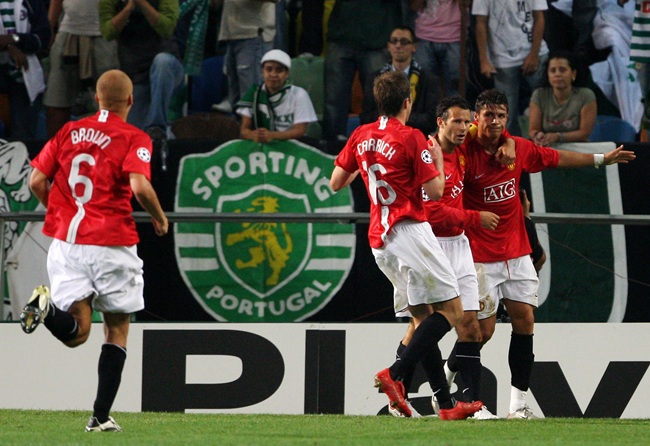
For six decades now, the histories of the two clubs have been inextricably intertwined. They have shared managers, players, European duels and even a stadium inauguration. Both clubs share the same passion for the importance of developing homegrown players for the first-team squad and are known for their ferociously passionate supporters. There isn’t, in the history of Portuguese football, another club that is so deeply linked to a British club as Sporting CP is with Manchester United. Who knows what the next chapter of this recurrent emotional get-together will be.
 Back
 Top
| Privacy Statement Terms of Service Contact |
Refresh

|
All the best breaking news stories from Apex Football Lite. Optimised for feature phones and low end Android devices, Apex Football Lite helps users with legacy devices and poor network connectivity access the latest football news and live scores. Particularly relevant for breaking football news in Nigeria, Kenya and South Africa.