

 Voltar
AC Milan managed to put Thursday night’s disaster in Bournemouth behind them, responding well to beat Udinese 2-0 on Sunday.
Despite an injury crisis, Milan ended up securing a rather comfortable win over Udinese. Christian Pulisic got the team off to a great start with a moment of real quality early on. He brought down Luka Modric’s ball over the top with a lovely touch and then finished past Okoye.
Omari Hutchinson would get the second goal in the second half to ultimately make sure of the three points in what was an important bounce-back performance from Ruben Amorim’s side. It moves the Rossoneri up to fourth in the table, and Rohit Rajeev has the tactical breakdown.
Milan lined up in a 4-4-2 formation, with Sankhoun Diawara at left-back and Tomori operating at right-back.
Bartesaghi occupied the left midfield role, while Hutchinson played on the right. Pulisic operated just behind the lone striker, Gonçalo Ramos, in a supporting attacking role.
Milan’s attacking structure was particularly interesting, with no rigid positional framework. Instead, they relied on fluid rotations and situational adaptations to progress the ball.
One constant, however, was maintaining a back three during build-up. This was achieved through either Jashari or Modrić dropping deeper, depending on the situation and the space available.
Regardless of the rotations and positional adjustments, the end goal remained the same: establishing a 3-2-5 attacking structure.
How Milan arrived at that shape was secondary. The players were given the freedom to interpret their positions and adapt to the situation, provided the overall structure was maintained.
Milan employed several mechanisms to achieve their desired build-up structure, including the use of passing diamonds to progress possession from the back.
They adopted a patient, possession-oriented approach compared to Udinese’s more direct style. Milan averaged 6.2 passes per possession, against Udinese’s 4.9, reflecting the contrasting approaches of the two sides.
This aided Milan’s build up, and in this video we can see how Milan are patiently searching for gaps in Udinese’s press and the fluid nature of Milan’s system helped them
https://t.co/DvZ2rRg2X8
— Rohit Rajeev (@RohitRajee23232) October 26, 2026
Higher up the pitch, Milan relied on third-man combinations to link players and progress through Udinese’s defensive structure.
Here, we see Hutchinson, Tomori and Pulisic combining, with Pulisic making a movement into space to receive the third-man pass.
The first goal was the result of three things: the intelligence and technique of Pulisic, the vision of Modric and the lack of communication between Udinese players
As soon as the foul happens Vojvoda is dealing with Bartesaghi and Pulisic. While Vojvoda is focused on Bartesaghi he fails to inform James (no.14) about Pulisic’s run
Udinese relied heavily on building through the wide areas, something Milan recognised and used to their advantage by directing their press towards the flanks.
Milan recorded an overall PPDA of 10.38. They started aggressively with a PPDA of 7.2 before easing off after the opening goal. However, they raised the intensity again in the final 15 minutes, recording an impressive PPDA of 4.4.
Milan played in a 5-2-3 shape to counter the 3-2-5 shape of Udinese on the ball. Udinese resorted heavily to long-range efforts, and this appeared to be a deliberate tactical approach rather than simply a lack of alternatives.
With Milan crowding the central areas with bodies, Udinese looked to shoot from distance, potentially using the defensive congestion to obstruct Maignan’s line of sight. Nine of their 12 attempts came from outside the penalty area
Keeping Amorim’s principle of always maintaining three players in the defensive line in mind, we can see an interesting rotation here.
As Koni De Winter pushes forward to join the attack, Modrić drops back to occupy his position. This ensures Milan retain their three-man rest defence, providing defensive security and minimising the opposition’s opportunities to launch counter-attacks.
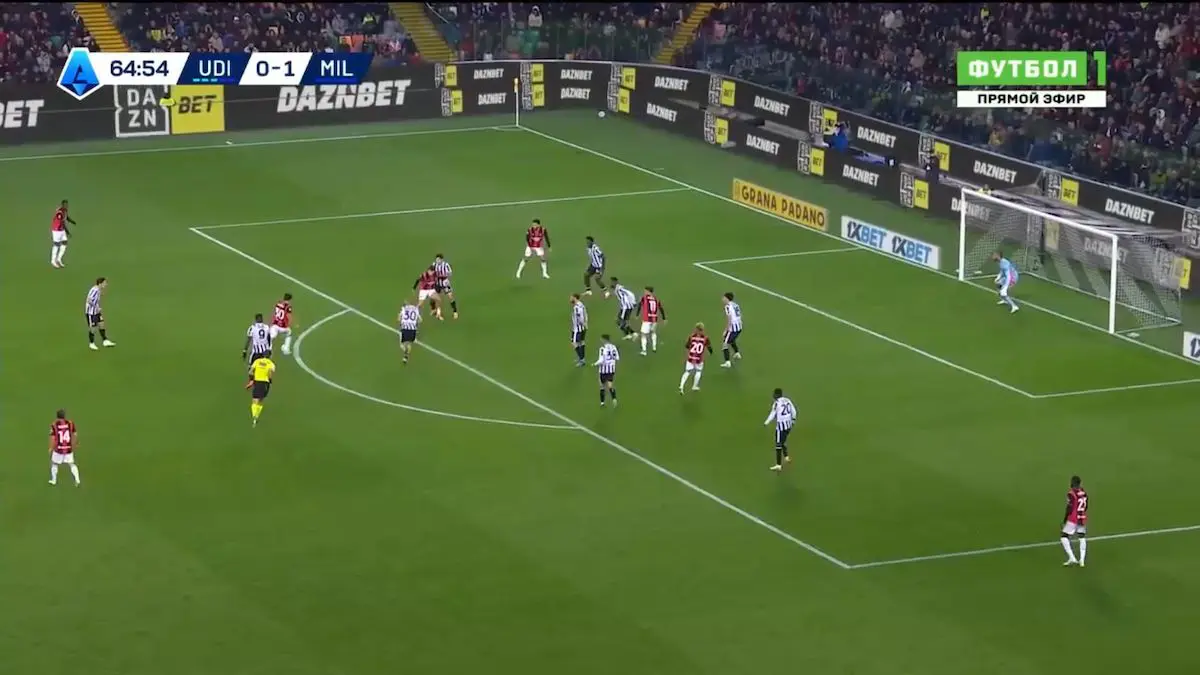
Milan’s second goal once again originated from an overload on the left flank. By creating a passing diamond, they were able to find Pulisic and progress the attack. Hutchinson subsequently found Jashari, who exploited a small gap between Udinese’s defenders to get his shot away.
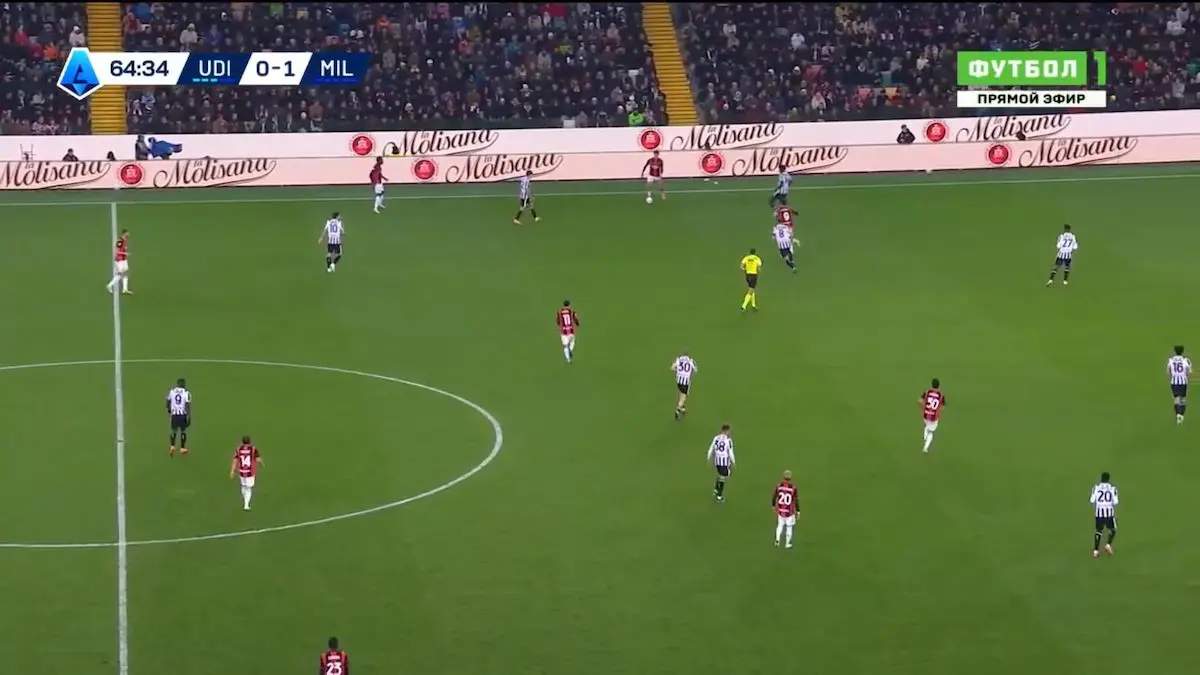
The visibility issue discussed earlier may have affected Okoye again. With a defender obstructing his view, his reaction was delayed.
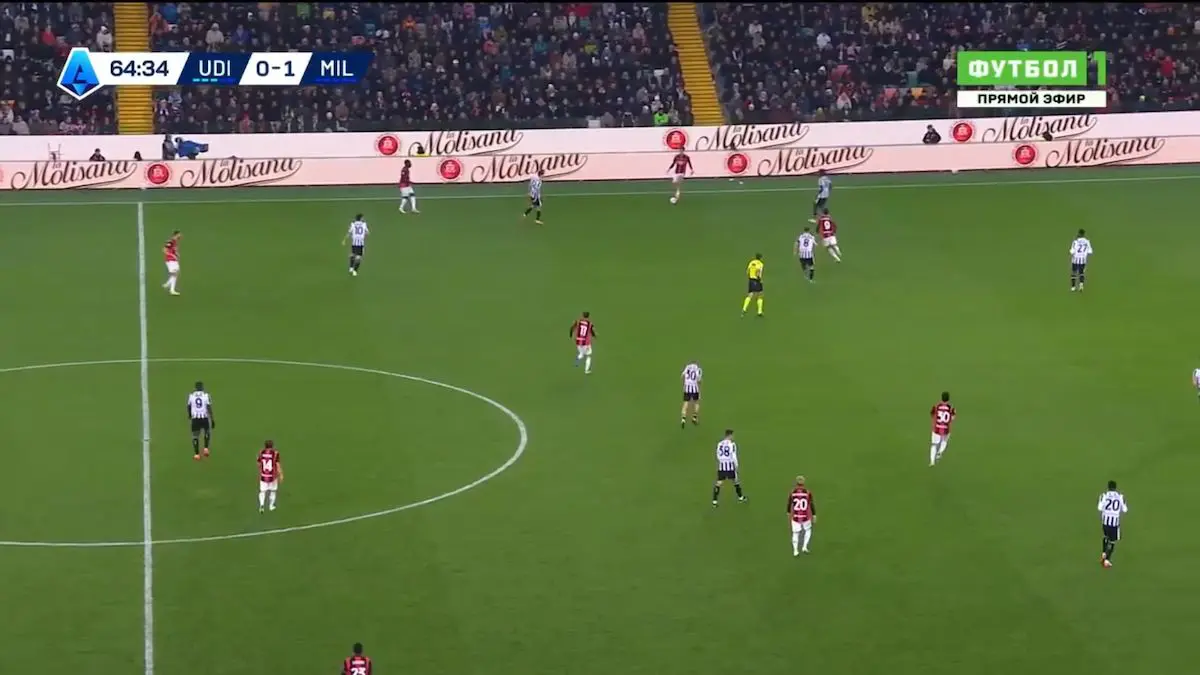
Although he managed to save Jashari’s initial effort, he could only parry it into the path of Hutchinson, who had escaped Lennon Miller’s attention and reacted quickest to convert the rebound.
➤ 15 accurate positional attacks: Milan consistently created and executed structured open-play attacks, excluding counter-attacks.
➤ 10 recoveries in the opposition defensive half: Highlighting their ability to win possession high up the pitch and sustain attacking pressure.
 Voltar
 Top
| Declaração de privacidade Termos de serviço Contact |
Atualizar

|
All the best breaking news stories from Apex Football Lite. Optimised for feature phones and low end Android devices, Apex Football Lite helps users with legacy devices and poor network connectivity access the latest football news and live scores. Particularly relevant for breaking football news in Nigeria, Kenya and South Africa.